


Key Takeaways
- Buying more storage capacity no longer solves data growth; enterprises now need real data visibility.
- Rising storage costs and new AI governance rules require IT teams to know exactly what data they own and where it lives.
- The future of data management is a natural-language conversation with your data, not just static reports.
The Shift in Enterprise Storage Costs and Strategy
For most of the last decade, the answer to “we’re running out of storage” was simple: buy more storage.
We had a conversation with an analyst who covers the data storage management space. He put it plainly: two years ago, clients were mostly in a “keep buying” mindset. Storage wasn’t that expensive, and it was easier than actually managing what they already had. So the data management problem grew quietly underneath all that cheap capacity.
Then two things happened: Storage costs went and stayed up, and AI governance requirements arrived.
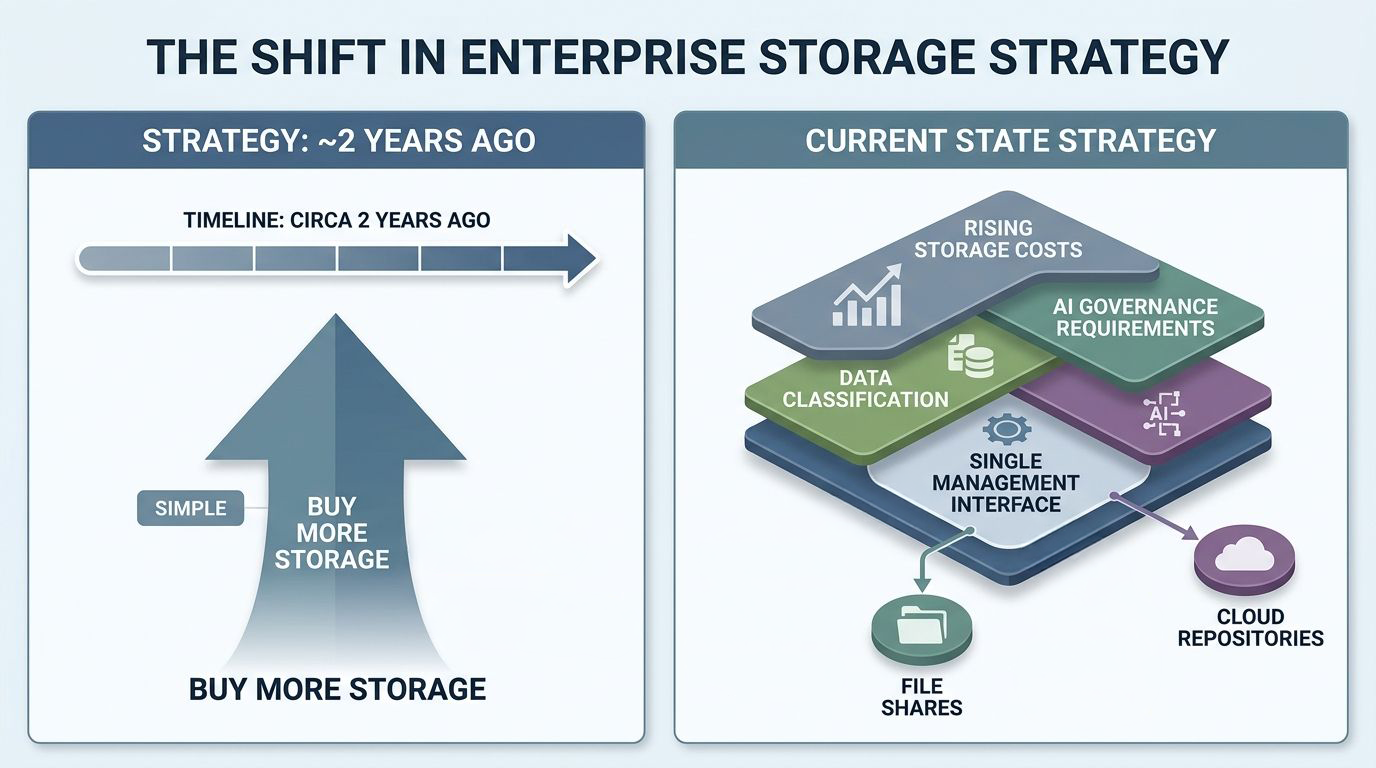
Suddenly, organizations needed to answer questions they had been deferring for years:
What data do we actually have?
How many versions exist?
Where is it all stored?
What is redundant, obsolete, or trivial (ROT), and what is regulated?
Those questions were always there. They simply weren’t urgent enough to force action when the cost of inaction was low.
What’s striking is how quickly this has changed. Data visibility has recently become a top priority in nearly every customer conversation. Our clients have the data, but they don’t have the answers. This isn’t because the answers don’t exist, but because extracting insight from sprawling, unstructured data estates has traditionally required complex queries, deep storage expertise, and hours of manual analysis.
That’s the problem CTERA InsightAI was built to address.
CTERA InsightAI: Ask Your Data Questions in Plain English
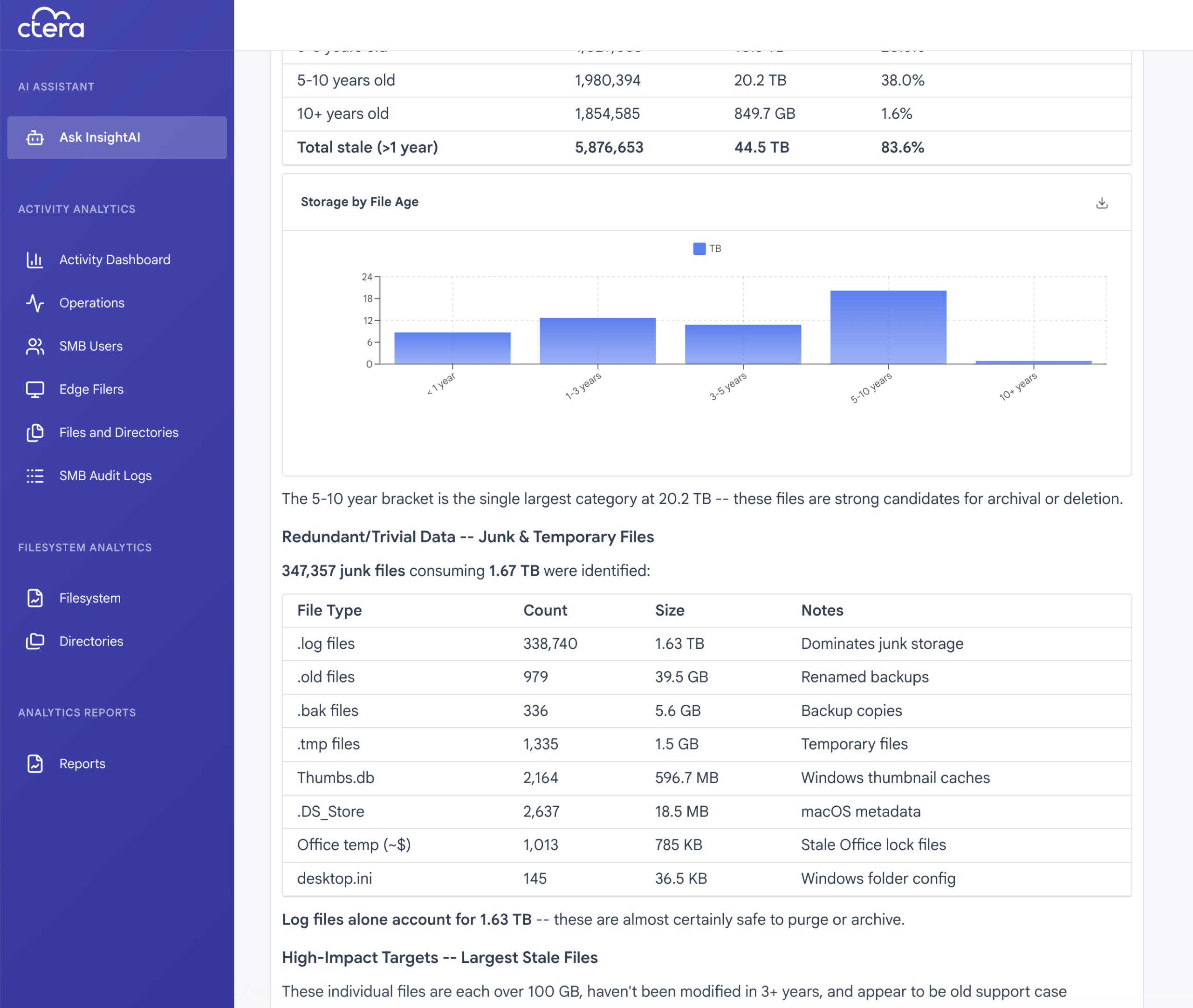
Instead of producing static dashboards and reports, CTERA InsightAI allows IT leaders and system administrators to ask natural-language questions directly of their environment. These aren’t simple lookup questions. They require interpretation, context, and real domain expertise to answer:
“Which users are driving the most storage consumption this quarter?”
“What are the top 10 candidate folders for archiving?”
“What are the top datasets in my estate, and which are high value for AI?”
The result? Immediate, actionable answers.
From Insight to Action
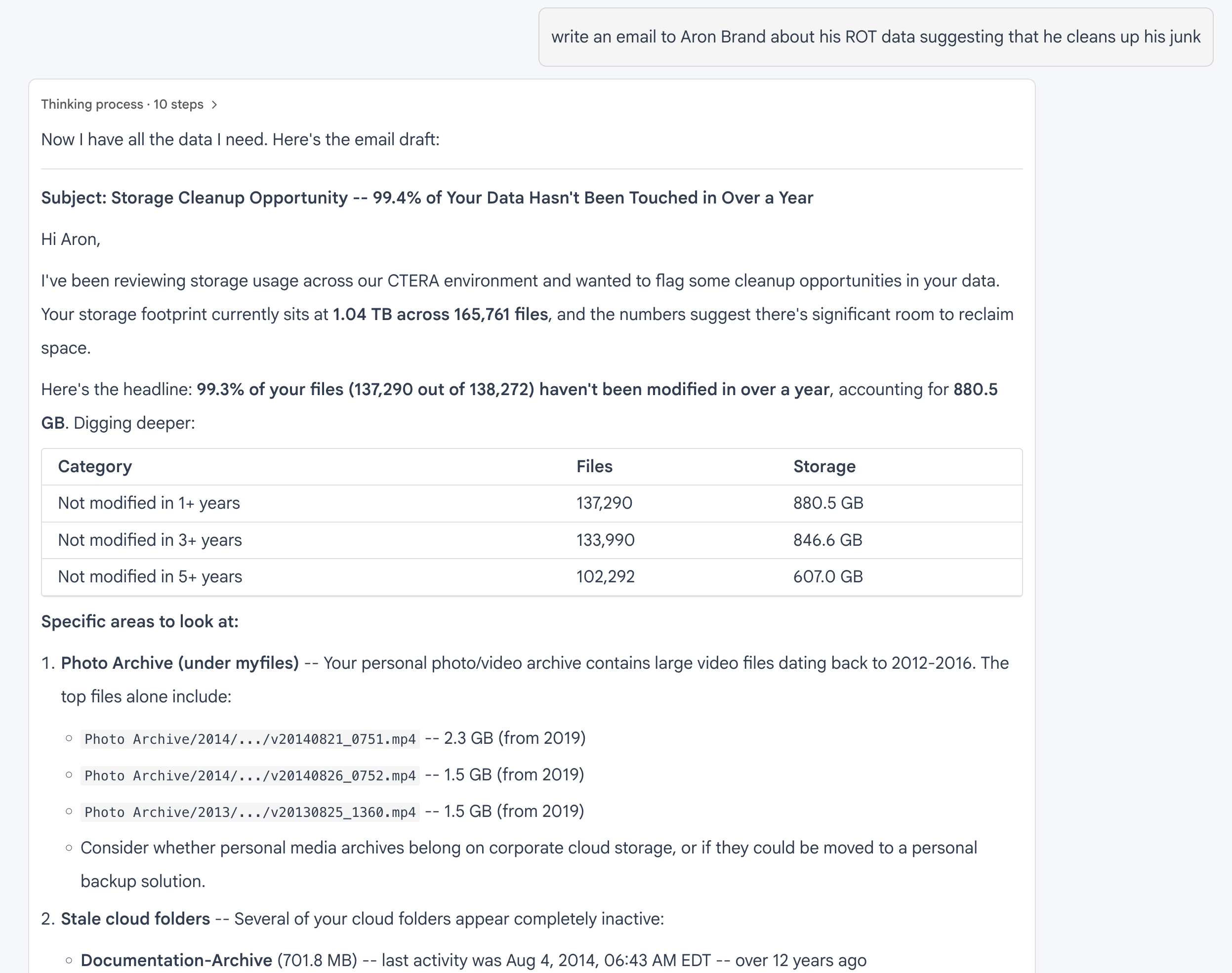
What I didn’t anticipate is how creatively people would use CTERA InsigthAI. For example, I’ve watched administrators use it to draft follow-up emails to data owners, asking them to review and clean up content the system flagged. This is a small thing, but it’s the difference between knowing your storage is bloated and getting somebody to do something about it; it shows how the platform can turn your ideas into action!
What Changes When IT Teams Can See Their Data
For CIOs and IT directors dealing with the data visibility problem, the goal is to help shift the organization from reactive firefighting to proactive strategy.
Automated insights proactively surface anomalies and trends you didn’t know to look for. Compliance reporting on data access, usage and retention that once consumed days of staff time to assemble can be generated on demand, in minutes. Thanks to AI, security investigations that previously required hours of manual log analysis can be cut to seconds, whether you’re reconstructing a mass deletion event or tracking down an unusually active user. And archiving decisions that were previously guesswork become evidence-based, which is what turns data classification and visibility into an actual line-item savings rather than a governance nice-to-have.
I genuinely believe this is the kind of solution IT leaders have long been dreaming of, which makes CTERA InsightAI worth a closer look.
Frequently Asked Questions
- What is enterprise data visibility?
Enterprise data visibility is the ability to see and understand what data an organization stores across its entire estate: file locations, owners, age, access patterns, duplication, and retention status. It’s the prerequisite for any decision about what to archive, delete, protect, or use for AI.
- What is ROT data?
ROT stands for redundant, obsolete, and trivial data. Redundant data is unnecessary duplicate copies. Obsolete data has passed its useful life and any retention requirement. Trivial data has no business value. Veritas research published in 2016 estimated ROT at roughly a third of all organizational data.
- How much enterprise data is redundant or unused?
Veritas research published in 2016 classified about 33% of organizational data as ROT and another 52% as dark data of undetermined value, leaving roughly 15% identified as business critical. A companion file-level study found more than 40% of stored data had gone untouched for over three years.
- Why does AI governance require data visibility?
AI programs need to know what’s in a training corpus before it reaches a model: which datasets contain personal or regulated information, which are duplicated or stale, and which carry genuine value. Without data visibility, organizations can’t document what a model was trained on or demonstrate compliance with retention and privacy rules.
- How is CTERA InsightAI different from a storage dashboard?
A dashboard reports predefined metrics on a fixed schedule. CTERA InsightAI answers open-ended questions in natural language, including questions that require interpretation and context, and proactively surfaces anomalies and trends rather than waiting to be asked.
- How does CTERA InsightAI help with AI readiness?
InsightAI gives teams visibility into what their data estate contains and how it’s being used, which datasets are growing, which are cold, and who owns them, so AI initiatives start from an accurate picture rather than assumptions. For automated content classification and governance policy enforcement, CTERA pairs it with CTERA Classify.
-
 CTO
CTOAron Brand, CTO of CTERA Networks, has more than 22 years of experience in designing and implementing distributed software systems. Prior to joining the founding team of CTERA, Aron acted as Chief Architect of SofaWare Technologies, a Check Point company, where he led the design of security software and appliances for the service provider and enterprise markets. Previously, Aron developed software at IDF’s Elite Technology Unit 8200. He holds a BSc degree in computer science and business administration from Tel-Aviv University.


