The problem isn’t just cost, it’s systemic inefficiency.
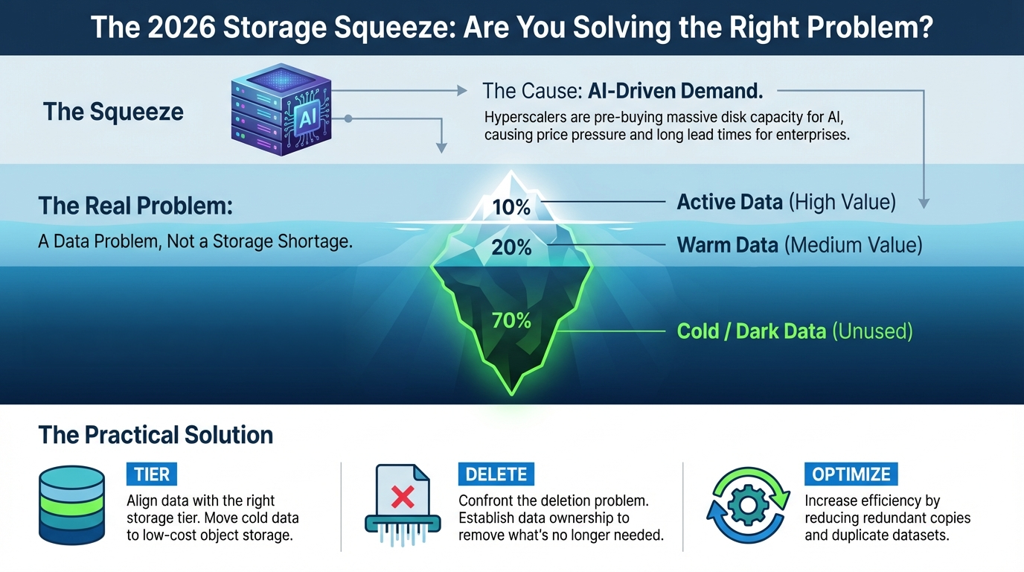
Organizations keep accumulating data because ownership is unclear, deletion feels risky, and storage has historically been cheap enough to ignore the issue. Now that supply is tightening, that habit becomes expensive very quickly.
AI Is Making the Problem Worse
AI workloads don’t just consume data; they generate it continuously.
Training pipelines produce intermediate datasets, logs, checkpoints, and duplicated copies across environments. In many cases, those artifacts are never cleaned up.
So, while storage supply is tightening, demand is accelerating in a fundamentally different way. It’s no longer just human-generated data growth. It’s machine-driven, continuous, and compounding.
That’s why vendors are seeing capacity effectively pre-sold years in advance.
Why Cloud Storage Costs Are Rising Even as Prices Hold
Interestingly, cloud object storage pricing has remained relatively stable. Services like Amazon S3 and Azure Blob haven’t seen visible price increases (so far).
But many organizations are still seeing their storage bills go up.
That’s because the cost drivers have shifted. It’s no longer just about dollars per terabyte. It’s about how often data is accessed, how much is moved, and how many operations are performed.
AI pipelines tend to be extremely “chatty,” which amplifies request and transfer costs even when base storage pricing stays flat.
So, while object storage remains one of the cheapest places to put cold data, inefficient usage patterns can quietly inflate total spend.
How to Reduce Storage Costs
There’s no single fix, but there are a few approaches that consistently make a difference.
One is aligning data with the right storage tier. A surprising amount of cold data still sits on expensive primary systems. Moving it to lower-cost object storage can reduce both cost and pressure on on-prem infrastructure.
Another is confronting the deletion problem. This is where most strategies stall. It’s not a technical limitation; it’s organizational. Without clear data ownership and accountability, everything gets retained indefinitely because nobody is comfortable approving deletion.
Efficiency is another lever. Even without deleting anything, many environments are full of redundant copies and duplicate datasets. Reducing that footprint can have an immediate impact.
The most effective enterprises go a step further and treat storage as fluid rather than static. Data moves across tiers over time based on usage, without disrupting users. That flexibility becomes critical when supply tightens.
Why Is It So Hard to Manage Costs Effectively?
If the solutions are relatively straightforward, why don’t more organizations implement them?
Mostly likely because the friction isn’t in the ideas but in the execution. The following operational roadblocks appear time and again:
Poor Visibility: Access patterns are often misunderstood because many organizations lack clear visibility into which data is actually being used versus which is sitting idle. Without that visibility, everything gets treated as potentially important, so nothing moves.
Compliance Fears: Even when data appears stale, teams worry about retention requirements, audits, or future legal needs. The safest option becomes keeping everything indefinitely.
Data Migration Barriers. Moving large datasets between tiers or locations can be disruptive, time-consuming, and risky. Concerns about downtime, performance impact, or broken workflows often lead teams to defer action.
Fragmented Ownership: Let’s not forget about the human factor. Data ownership is so scattered across teams, departments, and individuals that getting agreement to delete or move data, or even figuring out who the actual data owner is, can take longer than the technical work itself. Often, no one feels empowered to make the call.
The result is predictable: data accumulates, costs grow, and inefficiencies compound over time.
How CTERA Customers Handle the Enterprise Data Storage Squeeze
If you’re already using CTERA, this is one of those moments where the architecture quietly pays off.
Data can move between on-prem. systems and cloud object storage without downtime, all in the background, while users continue working as usual. This makes it much easier to push cold data out of expensive storage tiers without operational friction.
Because of global deduplication, the actual physical footprint is often far smaller than expected, which reduces exposure to rising disk costs. And since only a minimal working set needs to stay on-prem., the impact of hardware price increases is significantly softened.
Just as importantly, the new CTERA InsightAI helps identify not only stale data but also the people responsible for it, which is something most organizations struggle with. This turns the idea of data cleanup into something actionable.
Key Takeaway: Stop Storing What You Don’t Need
Yes, a storage squeeze is emerging in 2026, driven largely by the demands of AI infrastructure.
But for most enterprises, the bigger issue isn’t access to storage. It’s how marvelously inefficient their storage usage has become over time.
Before investing in more capacity, it’s worth asking a simpler question:
How much of what we’re storing actually needs to be there?
Because in many environments, the fastest way to deal with a storage squeeze
is to stop storing so much data in the first place.