The High Price of Storing Cold Data: Why the Global File System Is the Smarter Investment
Paying solid-state drive (SSD) prices for mostly cold data is getting a little crazy.
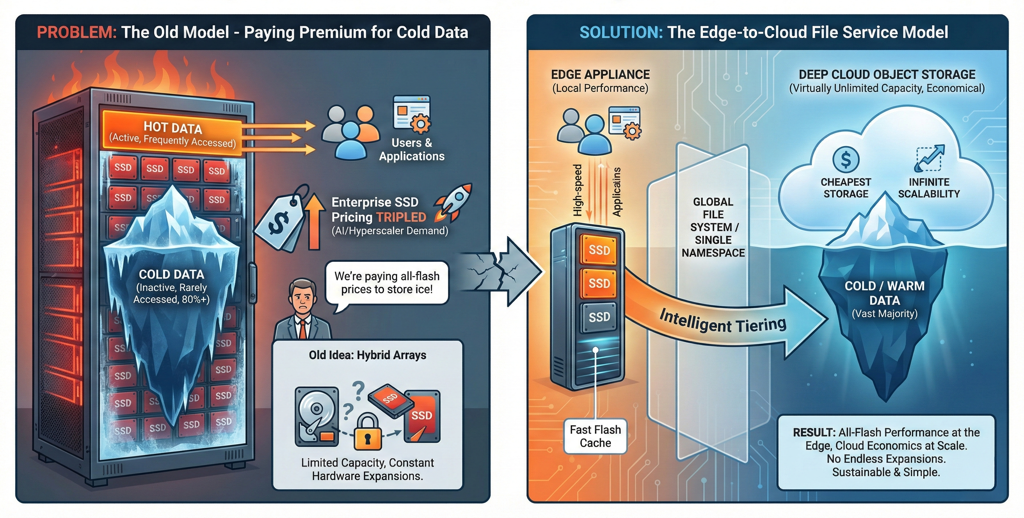
Over the past year alone, enterprise SSD pricing has almost tripled. The demand from AI buildouts and hyperscalers for flash storage has turned it into a scarce, premium resource. At the same time, most enterprise file data is cold. It is rarely accessed, yet organizations keep paying SSD prices just to keep it online.
Some vendors respond by saying, “Fine, let’s mix flash and disk in the same box.” That’s an old idea that keeps customers trapped in on-premises hardware thinking, forcing them to buy more capacity as their data grows.
While this sounds reasonable, the approach has fundamental limitations that many organizations discover too late, such as hardware lock-in and endless capacity expansion.
A Smarter Approach to Data Storage
There is a much cleaner way to look at the problem.
Hot data belongs on flash. Cold data belongs on the cheapest, most scalable storage available, which is deep object storage. The real challenge is making that split invisible to users and applications.
Here’s the uncomfortable truth most storage vendors won’t tell you: research indicates that 60-80% of enterprise file data qualifies as “cold,” or infrequently accessed files that sit idle for months or years. Compliance archives, completed project files, historical records, and backup datasets rarely need the access speed that SSDs provide.
Yet most organizations continue paying premium flash prices for this dormant data simply because it needs to remain accessible for that one, remote occasion that a file from years ago is accessed. This approach made sense when SSD costs were more affordable, but in today’s market, it’s a budget nightmare.
How Hybrid Cloud File Services Solve the Storage Cost Crisis
This is where hybrid cloud file services fundamentally change the game. Active data stays cached on fast SSDs at the edge, right where users and workloads need it. The vast majority of cold or warm data lives in deep object storage in the cloud, where capacity is virtually unlimited, and the economics actually make sense.
It’s one global file system, one namespace, no endless hardware expansions.
This approach delivers the key promise of a data fabric at the storage layer: location-independent access, policy-driven data placement, and dramatically better economics without changing how users or applications work.
All-Flash Performance without the All-Flash Price Tag
The result is all-flash performance where it matters, at the point of user access, without paying all-flash prices for petabytes of cold data that don’t need it. Organizations implementing hybrid cloud file services typically report 50-70% reductions in total storage costs while simultaneously improving remote user experience and eliminating hardware refresh cycles.
As the industry starts to accept that stuffing petabytes of cold files onto SSDs is financially unsustainable, the conclusion is obvious: Stop arguing about flash versus disk and start putting your data where it belongs.
The Industry Is Reaching an Obvious Conclusion on Enterprise SSD Cost
As enterprise SSD prices continue climbing and AI demand shows no signs of slowing, the financial case for intelligent data placement grows stronger every quarter.
The organizations that thrive will be those that stop arguing about flash versus disk and start putting their data where it economically belongs: hot data on fast storage, cold data on cheap storage, and a smart layer in between that makes the distinction invisible to users.

Frequently Asked Questions
- What percentage of enterprise data is considered cold?
Research consistently indicates that 60-80% of enterprise file data is cold, meaning it’s accessed infrequently or not at all, yet must be retained for compliance, historical reference, or potential future use. This percentage tends to increase over time as organizations accumulate more data while active working sets remain relatively constant.
- How do hybrid cloud file services handle data migration between tiers?
Unlike traditional storage tiering that physically moves files between storage pools, hybrid cloud file services use a caching model. The authoritative copy of all data resides in object storage, while frequently accessed files are automatically cached on local flash storage. This approach eliminates complex migration policies and ensures data is always accessible regardless of access patterns.
- Can I maintain existing file permissions and workflows with cloud object storage?
Enterprise hybrid cloud file services preserve full Windows ACL support and integrate with existing Active Directory infrastructure. Users and applications interact with familiar SMB/NFS protocols and file paths; the underlying object storage architecture is completely transparent to end users.
- How do hybrid cloud file services perform for remote and branch offices?
Smart caching at edge locations ensures remote users experience local-like performance. Frequently accessed files are served from nearby cache; less common files are retrieved from cloud storage. This architecture actually improves remote access compared to traditional centralized NAS, where all traffic traverses WAN connections.
- What happens to cached data if the internet connection fails?
Enterprise hybrid cloud file services maintain local cache availability during network outages. Users can continue accessing and even modifying cached files. Changes synchronize automatically when connectivity resumes, with conflict resolution handling simultaneous edits.
-
CTOAron Brand, CTO of CTERA Networks, has more than 22 years of experience in designing and implementing distributed software systems. Prior to joining the founding team of CTERA, Aron acted as Chief Architect of SofaWare Technologies, a Check Point company, where he led the design of security software and appliances for the service provider and enterprise markets. Previously, Aron developed software at IDF’s Elite Technology Unit 8200. He holds a BSc degree in computer science and business administration from Tel-Aviv University.